Banking a Fire Overnight: Coal Beds, Ash, and Damp Ground
Relighting a fire in the morning is easy if there is a bed of coals under the ash, and miserable if there is not. Banking is the practice of arranging the fire so it burns slowly for hours instead of brightly for one, and it depends far more on what is under the flames than on what is stacked on top.
The coal bed is the whole trick
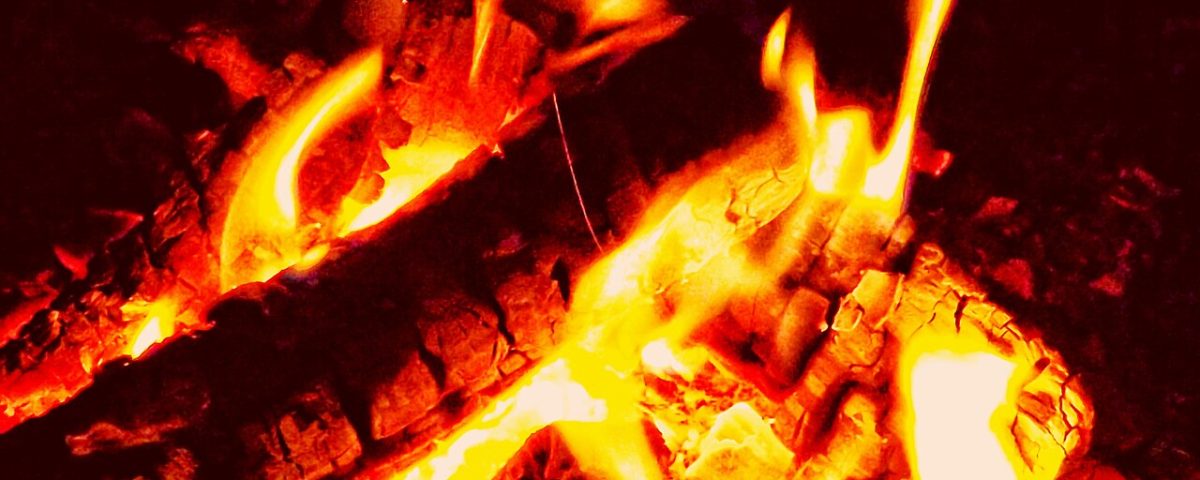
Wood burns in stages. Flames consume the volatiles, and what remains is charcoal, which burns hot and slow with almost no flame. A fire that has been burning for two hours has a bed of that charcoal at its base, and that bed is what carries heat through the night.
Dense hardwoods leave more and better coal than softwoods, which flare, throw sparks, and collapse into fine ash. That is the practical reason hardwoods are preferred for a long fire, and the reason a pile of spruce and pine will be cold by midnight no matter how large it was.
Ash is insulation. A layer over the coals slows the air reaching them, which slows the burn. Too little ash and the coals are consumed by two in the morning; too much and the fire suffocates. Roughly a finger’s depth over the coal bed is the working range, adjusted by how much coal is underneath.
The mechanics of banking
An hour before you want to sleep, stop feeding small wood. Push the coals into a compact mound toward one side of the fire area, lay two or three rounds of dense wood over them, and draw ash up around the base. The goal is a small, hot core with fuel above it and air restricted around it, not a big fire with a lid on.
If you have stones, a ring of them around the mound radiates heat back and blocks wind. If the ground is wet, build on a platform of green logs or a flat rock, because wet ground pulls heat out of the coal bed faster than cold air does and a fire on saturated soil will die quietly.
For a wood stove, banking means closing the damper down after a load of large splits and letting the coal bed take over. The same principle, with the advantage that air is controlled for you.
Wood choice and preparation
Split rounds burn hotter and coal better than whole ones, because the exposed surface drives off moisture and the pieces settle into a dense bed. A round left whole will smolder at one end and leave a log you have to deal with in the morning.
Dry matters more than species. Any wood above about twenty percent moisture spends its energy boiling water rather than making heat, and green wood smolders, smokes, and leaves creosote. If the only wood is damp, split it and bring the dry inside faces together; the fire will dry the rest.
Keep a separate, covered pile of small dry wood for the morning. Relighting is a two-minute job with dry twigs and a coal; without them it becomes a twenty-minute project with cold hands.
Site, rules, and the ground under you
Check what the land allows before you build anything. Many areas require fires in established rings, ban them entirely in dry seasons, or restrict them above a certain elevation, and a fire that starts a root system burning is not a small mistake. Ground fires in peat or deep duff can smolder underground for days and surface somewhere else.
Clear a wide area down to mineral soil, keep water within reach, and never bank a fire inside a tent or a sealed shelter. A charcoal fire in a confined space produces carbon monoxide, and a shelter that holds heat also holds gas.
In the morning, cold ash can hide live coals for a long time. Stir it, add water, and check with the back of your hand before you walk away, which is also the rule in places where the ground itself can burn.
When banking fails
Rain is the obvious killer, and the failure is not the water on the wood but the water soaking the ash and cooling the coal bed from above. A cover, even a sheet of bark or a folded tarp corner on sticks, is worth the trouble if the forecast is wet.
Wind is the second. A banked fire in a strong draught burns like an open fire, and the coal bed is gone by three in the morning. Build the mound on the lee side of a windbreak, or accept that the fire will need feeding.
And a small fire cannot be banked. If the coal bed is the size of your two hands, there is nothing to carry heat for eight hours; the answer is more fuel earlier in the evening, not more ash at bedtime.
Banking is a habit rather than a technique. Once you start setting the fire up for the morning while you still have light, the morning stops being a problem.
The night you get it right, you will wake up to a bed of coals, a kettle that heats in four minutes, and no need to explain yourself to anyone.