Bank Line, Paracord, and Jute: Choosing Bushcraft Cordage
Most cordage advice is about tensile strength, which is the one number that rarely decides anything in the field. A ridgeline does not fail because the cord was rated to two hundred kilograms; it fails because the sheath wore through on bark, the knot slipped when it got wet, or the sun cooked it over two summers in a stuff sack. Pick cordage by what it has to survive, then by strength.
What cordage actually has to do
Four jobs cover almost everything: hold a static load like a ridgeline or a gear hang, hold a dynamic load like a tarp in gusts, survive abrasion against bark and rock, and hold a knot under tension when wet. A cord that is strong but slick fails the fourth job and takes the first one with it.
Knot retention is the most underrated property. Slippery synthetic line needs extra half hitches or a friction hitch, and in the dark with cold hands those extra steps are where the mistake happens. A slightly rougher cord that takes a taut-line hitch on the first try is worth more than a stronger one that needs three attempts.
Tarred bank line
Bank line is twisted nylon, tarred, and sold by number. Number 18 is about 1.8 millimeters and holds somewhere in the range of forty-five to seventy kilograms depending on the batch; number 36 is roughly 2.5 millimeters and considerably stronger. It is cheap enough to leave in place, stiff enough to push through a loop without a needle, and rough enough that knots stay where you put them.
The tar resists water and rot, which makes it good for lashings that stay up for weeks. It also means you do not want it against bare skin for long, and it degrades in ultraviolet light like any nylon. A lashing left in the sun for a season loses a large share of its strength without looking any different.
Paracord and its limits
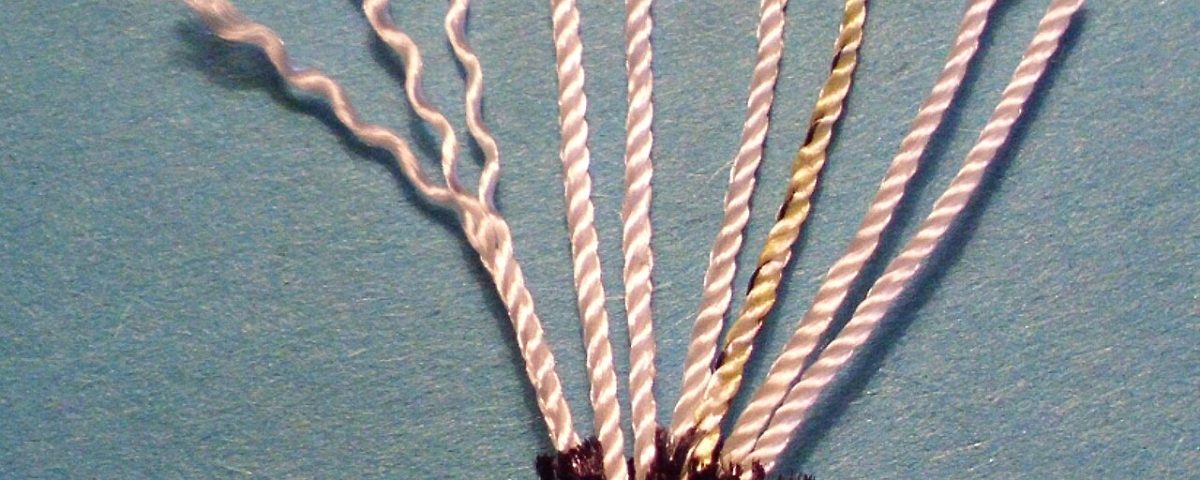
Genuine 550 paracord has seven inner strands inside a woven sheath, and the split between core and sheath is both its advantage and its problem. You can gut it and use the sheath for fine lashing, or pull strands for sewing and fishing. But the sheath slides over the core under load, which is why paracord stretches, creeps, and needs retensioning after the first cold night.
It is also poor at holding knots compared with bank line, and bulky for its strength. Where it earns its place is as a reserve: a hank of it covers shelter lines, repairs, hoisting, and improvisation, and its elasticity is useful when you want a line to absorb shock rather than pass it along.
Natural and improvised cordage
Jute twine, sisal, and hemp are cheap, hold knots beautifully, and burn, which makes a few meters of jute a legitimate fire-starting material as well as a tie. Their weakness is rot. Wet natural fiber left in place grows weak and then grows mold, and a jute lashing that held in October can part in a spring wind with no warning.
Improvised cordage from inner bark, spruce roots, or nettle fiber is worth learning because it teaches what cordage has to do. It is also slow, and it is a bad plan for anything that must hold weight the first time. Treat it as a skill and a backup, not a supply.
Store cordage wound in a figure-eight around thumb and elbow rather than in a tight ball. Coiled line takes a set, kinks on the first throw, and a kink under load is a weak point that will not announce itself until the tarp is up and the wind arrives.
When the choice stops mattering
Every cord fails at a sharp edge. A line running over a rock lip or a sawn branch stub will cut through under load no matter what it is made of, and the fix is geometry rather than a stronger cord: a wider bearing surface, a stick under the line as a chafe guard, a wrap of cloth. Almost every field cordage failure I have seen was abrasion, not tension.
Cold changes the picture too. Wet nylon stiffens below freezing, knots tighten beyond what bare hands can undo, and anything tied with a simple bow will have to be cut. In winter, tie with knots you can release while wearing gloves, and expect to leave some cord behind.
And if a load is genuinely critical, none of this applies. A person, a boat, a vehicle: those need climbing-rated cordage and hardware, and hardware store rope is not a substitute for either.
Two sizes cover the useful range: something near two millimeters for lashings and tie-outs, something near four to five for ridgelines and hauling. Carry both, add a few meters of jute for fire and fine work, and you will stop improvising with shoelaces.
The best cordage decision is made before the trip, when you can measure, cut, and seal the ends. Field-cut cordage unravels, and an unraveled end is where failures start.