Signaling for Rescue: Whistle, Mirror, and Fire by Range

Being found is a technical problem with a hierarchy. A whistle reaches a searcher a few hundred meters away, a mirror can be seen from an aircraft many kilometers out, and a fire is only useful if someone is looking in the right direction. Choosing the wrong signal for the range wastes the one thing you cannot manufacture, which is the attention of someone who is already looking.
First, make yourself findable on paper
No signal works if nobody knows to look. Leave an itinerary with someone reliable: where you are going, which route, when you expect to be back, and when to call for help. A vehicle at a trailhead with a note on the dash does some of this, and a message to a person does the rest.
The other half is staying put when you are lost and someone knows your plan. Searchers work from a last known point outward, and a moving target makes their job much harder. Move only for shelter, water, or a better signaling position, and leave a clear indication at the point you left.
Whistles: close range, bad weather, low cost
A whistle carries further than a voice, costs almost no energy, and works when your throat is dry. Three blasts is the universal distress signal, and the answer to a search whistle is usually the same three blasts back. A plastic whistle with a pea on a cord around your neck is the version that survives, because the ones in a pack pocket are the ones that are not there.
Its limit is terrain and vegetation. In dense forest, in wind, or over a ridge, sound is absorbed and deflected, and effective range may be a few hundred meters or less. Blow in bursts with pauses, and stay in one place long enough for a searcher to close the distance rather than moving between blasts.
Mirrors and lights: distance and direction
A signal mirror works by geometry: sunlight reflected off a flat, mirrored surface can be aimed. The trick is to hold the mirror close to your eye, sight through the hole or the notch at the target, and use the bright spot of reflected light on your hand or a stick to steer the beam onto the target. Practice it once in daylight before you need it, because aiming a mirror for the first time while an aircraft passes is not a good first lesson.
Range depends on the sun, the air, and the target, but a flash from a mirror can be visible from an aircraft far beyond the range of any other hand-held signal, and it needs no battery. At night, a light does the same job: sweep it toward the sound of an aircraft or a vehicle rather than waving it randomly, and hold it steady when you think you have been seen.
Both fail in cloud, in fog, and in terrain that blocks line of sight, which is most of the reason to carry more than one method.
Fire and smoke: the long-range option
A fire is visible at night from a long way, and smoke is visible by day. Three fires in a triangle or a straight line is the recognized distress pattern, and spacing them well apart matters more than size. Green boughs or wet leaves on a hot fire make white smoke that reads against dark forest; oil-based material makes black smoke that reads against snow.
Keep a signaling fire laid but unlit, ready to light in seconds when you hear an aircraft, and keep the means to light it dry and accessible. A fire that takes twenty minutes to build is a fire that misses the pass. Check whether fires are permitted where you are before you plan around one, and never leave one unattended in dry conditions.
Smoke signals fail in wind and in dense canopy, where a fire produces heat and no visible column. In forest, the clearing matters more than the fuel.
Ground signals, contrast, and being obvious
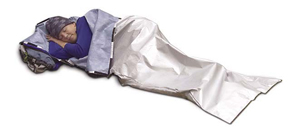
From the air, the thing that gets you seen is contrast and geometry. A large X, a V, or an arrow stamped in snow or laid out with dark branches on light ground reads at a distance where a person waving does not. Bright clothing spread out, a space blanket, or a tarp in an open area is often more visible than any light.
Movement catches the eye, which is why waving a dark object against snow or a light object against dark ground works when standing still does not. Do it when the aircraft is approaching, not continuously, because a person waving at nothing all day is a person who is tired when it matters.
When signaling fails
It fails when it starts too late. A signal is only useful once someone is looking, and the gap between becoming overdue and the search starting is measured in hours, sometimes a day. If you have a personal locator beacon or a satellite messenger, that device collapses the gap, and it is the only signaling method that works when nobody is looking yet.
It fails when it is aimed at the wrong place. Signaling into a valley wall that blocks the view, or lighting a fire under dense canopy, is effort spent where nobody can receive it. Move to a clearing, a ridge, or a riverbank, and accept the walk.
And it fails when the person signaling has stopped managing everything else. Signals are a supplement to shelter, water, and warmth, not a replacement. The rescue that arrives in two days is no use to someone who spent them getting colder.
Carry a whistle on a cord, a small mirror, and a lighter that works. Those three cost almost nothing and cover most of the range where a search actually happens.
Then make sure somebody knows where you went. That is the signal that does the most work, and it is sent before you leave.