Headlamp vs Handheld Light: Beam, Runtime, and Hands-Free Work
The light question in camp is not which is brighter. It is whether you need both hands, whether you need to see thirty meters ahead, and whether the battery will still be alive at two in the morning when something goes wrong. Those three questions point at different lights, which is why carrying one is usually a compromise.
What you actually use a light for
Most night light in camp is close work: cooking, finding something in a pack, reading a map, repairing a strap, dealing with a boot. That work wants a broad, even pool of light with no harsh hotspot, and it wants it without a hand taken up.
Walking after dark is different. It wants a beam with some reach to pick out the trail edge and the shape of the ground, and it wants the light aimed where you are looking rather than where your head happens to point. Searching for something off-trail wants a tight beam and the ability to sweep.
Three jobs, and no single light is good at all three. Knowing which one you are doing most of the night is the whole decision.
The headlamp case
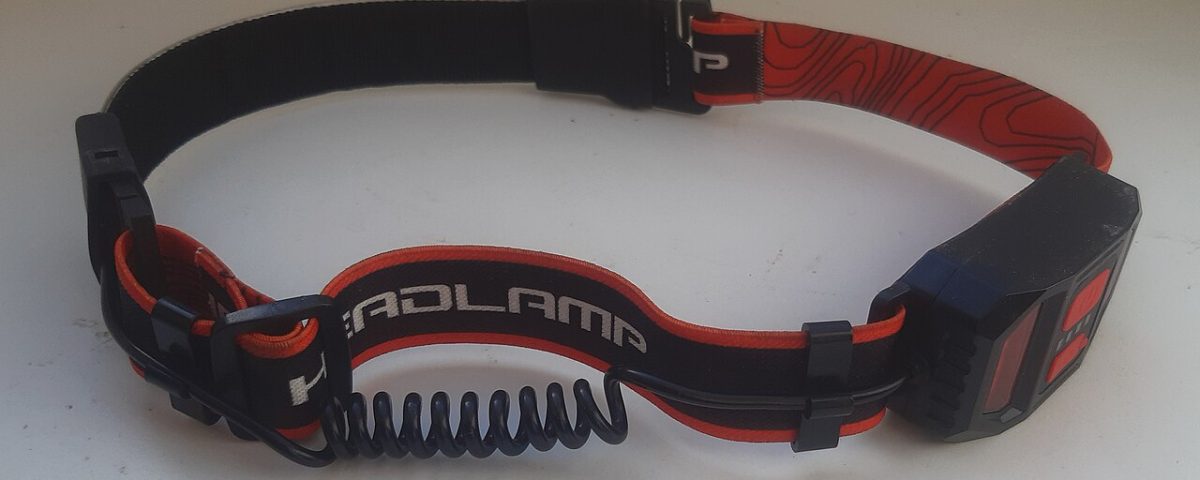
A headlamp frees both hands, which matters more than it sounds: cooking, pitching, and treating water all need two hands, and holding a light in your teeth is how people break a tooth. A strap-mounted light also puts the beam where your head points, which is roughly where you are looking.
Its weakness is depth perception. A light at eye level flattens the ground: shadows disappear, roots and dips stop reading as obstacles, and the beam throws a bright wash that hides texture. That is why walking with a headlamp at full power on uneven ground feels less secure than walking with a dimmer light held lower.
Glare is the second issue. Eye-level light shines into the eyes of anyone you talk to, and in a shared camp a bright headlamp is a social problem as much as a visual one. A low setting and a beam angled down fixes most of it.
The handheld case
A handheld light can be aimed independently of your head, held low to cast shadows that reveal terrain, and focused into a tight beam for finding a route or a marker. For night navigation, a handheld with real throw is often better than any headlamp, because you can point it at the thing you need to identify.
The cost is a hand. On a rough descent with trekking poles, or while carrying a load, that hand is not free, and a light you have to put down to use both hands becomes a light you leave in the pack.
The other advantage is that a handheld can be used as a signaling tool, held away from your body where it will not blind you, and pointed at a sound. A headlamp can do this too, but only by taking it off.
Beam pattern, output, and runtime
Lumens sell lights and candela tells you what the beam does. A light rated at a high output with a wide, even beam illuminates a tent beautifully and disappears at twenty meters. A light with a tighter reflector and lower output can put a usable spot on a tree a hundred meters away. Read the beam description, not the big number on the box.
Runtime is measured at a setting nobody uses. The honest way to compare is to ask how long the light runs at a mid setting you would actually walk with, and whether it steps down as the battery drains or holds output until it dies. A light that dims gradually is more useful than one that runs flat at full brightness and then stops.
Battery discipline matters more than battery type. Carry spare cells that match the light, keep them warm in cold weather because cold cuts capacity sharply, and know how to run the light on the lowest setting that works. A dim light you still have beats a bright one that is dead.
The failure cases
The classic failure is one light. A headlamp that dies at the wrong moment leaves you navigating by feel, and the fix costs almost nothing: a small backup light, ideally one that runs on the same cells, kept in a pocket rather than in the pack.
Fog and rain degrade both types through backscatter. A bright beam in fog lights up the water droplets and blinds you to everything beyond three meters, and the answer is a lower setting and a light held low and to the side rather than at eye level.
And a headlamp with a dying battery is worse than no light in one specific way: it encourages you to keep walking while you can still see a little. If the light is failing and the terrain is not trivial, stop, change cells, or stop for the night. The trail will still be there at dawn.
The practical setup is a modest headlamp with a good low mode and a small handheld with some throw, both on the same battery type. That covers camp, trail, searching, and signaling, with redundancy built in by accident.
Then use the low setting by default. Most night light is too much light, and the battery you save is the one you will want later.